From Australia
Jacob Nottage
5.0 out of 5 stars Informative and funny.
Reviewed in Australia on 9 April 2021
Format: KindleVerified Purchase
Great, short read.
Well structured and light enough to knock over in one or two sittings.
Highly recommend.
Helpful
Report
Australian born German
2.0 out of 5 stars The enemy of your enemy is not always your friend
Reviewed in Australia on 5 May 2024
Format: PaperbackVerified Purchase
I bought this book because it provides an insightful critique of the “polite” elite minion class. After all enemies are the best at spotting someone’s flaws.
I wasn’t disappointed in that respect but the author’s view are obviously distorted by her “progressive” Marxist viewpoints. Given that Marxists are responsible for over 150 million citizens murdered by their own government, in the 107 years since the Russian Revolution, on top of a similar amount of people killed as a consequence of spreading their “workers paradise”, I am obviously coming to different conclusions. Having said that I share her contempt for the soft-spoken psychopaths and mild-mannered mass-murderers she calls PMC. She obviously detests them for the wrongs reasons. She is just impatient.
Helpful
Report
From other countries
Raymond Losier
5.0 out of 5 stars Someone sees the truth!
Reviewed in Canada on 31 March 2025
Format: PaperbackVerified Purchase
i cannot say anything against the truth
Report
Lucas Cavalcanti Rodrigues
5.0 out of 5 stars Ressurgimento de conceito marxista do pós-guerra
Reviewed in Brazil on 16 August 2024
Format: PaperbackVerified Purchase
Eu realmente gostei desse livro. Em geral, o conceito de PMC vem da insatisfação de alguns marxistas do pós-guerra com insuficiência do modelo marxista de duas classes (capitalistas vs proletariado) para explicar sociedades modernas no século XX. Cada vez mais era claro a existência de um estrato intermediário. Para marxistas mais ortodoxos o tal estrato intermediário não era qualitativamente diferente da working class já que também era composto por pessoas que não possuíam capital e também dependem da venda da sua força de trabalho para viver. Quando muito esse estrato intermediário se distinguia pelo consumo apenas.
Outros marxistas, porém, decidiram romper com a ortodoxia e argumentaram que classe não se limita à posse de capital, mas também por cultura, redes de socialização e inserção produtiva. Dessa forma, os não-capitalistas em sociedades modernas se dividiriam em working class (dedicados à produção de mercadorias) e PMC (dedicados à replicação da ideologia que legitima o sistema). O papel dos PMCs, então, é eminentemente ligado à propaganda ideológica e, portanto, ao aparato intelectual e cultural da sociedade.
Neste ensaio, a autora retoma o conceito (originalmente pensado em 1977) e procura mostrar como lideranças e instituições aparentemente progressistas tendem a agir contra a classe trabalhadora ao promover visões de mundo e debates que passam ao largo de preocupações materiais ou de conflitos entre capital e trabalho. Dessa forma, os PMCs garantem sua sobrevivência econômica ao contribuir para repressão da classe trabalhadora (classe que, na visão da autora, os PMCs abominam e, em geral, não convivem socialmente).
O modelo básico é simples, mas gera alguns resultados interessantes. A escrita da autora é muito boa, então a leitura é bem agradável.
Report
Translate review to English
Christine
5.0 out of 5 stars Excellent dissection of the PMC. the good as well as the bad.
Reviewed in the United Kingdom on 19 April 2026
Format: KindleVerified Purchase
It’s not often these days I read something as interesting as this from a socialist perspective-that is a proper socialist perspective not a self described one. It was bloody refreshing. Easy to read, enjoyable and funny in places, it was still challenging. The examination of To Kill A Mockingbird I found new (to me, having never looked at it from that POV before). If you are interested in current politics I would recommend reading this.
Report
Patrick Cotter
5.0 out of 5 stars Forget the New Left this is the True Left.
Reviewed in Ireland on 25 April 2026
Format: PaperbackVerified Purchase
It takes a Marxist of colour such as Liu to cut though all the silage caking identity politics, painting it for what it is - a distraction from class war and economic privilege. She exposes all the self-delusions of the middle classes in their efforts to distance themselves from the culturally disenfranchised working poor; how the Professional Managerial Class are, in effect, functioning as useful idiots for Capitalism, while feeling virtuous about themselves.
Report
Amazon Customer
5.0 out of 5 stars Great book against the bougie worker-hating fake-left
Reviewed in France on 17 August 2021
Format: PaperbackVerified Purchase
Catherine courageously demystifies and attacks the culture of self-aggrandizing, self-mediatizing strivers and pleads for a return to class politics.
Report
Rodrigo Barreda Maza
5.0 out of 5 stars Excellent
Reviewed in Germany on 11 May 2024
Format: KindleVerified Purchase
Excellence
Report
Adam L
5.0 out of 5 stars great read def recommend
Reviewed in the United States on 18 March 2026
Format: PaperbackVerified Purchase
great read def recommend
Report
Client Amazon
1.0 out of 5 stars Socialistic rambling
Reviewed in France on 30 December 2023
Format: KindleVerified Purchase
Socialistic rambling. The points about the Professional Managerial Class are interesting, but criticizing the class because it's no longer socialist is ridiculous.
Report
Translate all reviews to English
Amazon Customer
5.0 out of 5 stars Excellent
Reviewed in the United States on 23 February 2023
Format: KindleVerified Purchase
Short but well-researched and straight to the point. The only point I have a real contention with is the assertion that the PMC (Professional Managerial Class) has decreed that sadism is not acceptable in any context. If that were true, economic wage slavery and the sadism of environmental and climate destruction would be unacceptable: they are, instead, the order of daily business. Every time you hear excuses for how some elite gets away with what the common rube would face prison for - that's the PMC, most especially in its tech-bro incarnation.
Report
JP
5.0 out of 5 stars How the class struggle is being waged today.
Reviewed in the United Kingdom on 30 July 2025
Format: PaperbackVerified Purchase
This is a thought provoking and persuasive analysis of how modern bosses anchor their untrammelled authority over workers - of all backgrounds - by mouthing empty platitudes about equality and diversity.
Report
Linda J. Page
5.0 out of 5 stars Opens my eyes
Reviewed in Canada on 21 December 2021
Format: KindleVerified Purchase
As a member of the PMC, I have long wondered about the reluctance of my colleagues to recognize this irony: talking about relieving suffering but ignoring or squelching attempts by our working class brothers and sisters to organize to do it. I don't see any other force that can do it.
Report
Tom101
5.0 out of 5 stars Gegen den Wokismus
Reviewed in Germany on 15 July 2023
Format: KindleVerified Purchase
Eine brilliant Streitschrift gegen die Wokness und für das Primat der Klassen rage.
Report
Translate review to English
bruja
4.0 out of 5 stars Sounds true
Reviewed in the United States on 5 March 2021
Format: KindleVerified Purchase
Funny and largely correct. I usually poke fun at these people and maybe pity them (some virtue hoarding myself?) but this book made me question whether that was the appropriate response or whether I was therefore even more complicit in furthering the country’s inequities.
Report
Pete D.
4.0 out of 5 stars If you want to understand why things are the way they are. Read this book.
Reviewed in Canada on 31 December 2023
Format: PaperbackVerified Purchase
If you've ever looked at the way society operates and thought "this makes no sense" you're absolutely right! However there are reasons for that. This book reveals some of those reasons so you can understand the dynamics at play. If you are the sort of person who went to university for the sheer pursuit of knowledge this will be an easy read for you. If you are a more practical sort of person, this will be a challenging read.You may want to have a dictionary or thesaurus handy. I fall somewhere in the middle and am finding myself understanding all the words in some of the more difficult sentences but having to read them over a few times to get the ideas to register. I don't get the impression that it's written to dazzle you with the intelligence of the author, but rather a phenomenon that seems to happen in academic circles where high powered language is required to get the Inteligencia to take you seriously. You must just get used to expressing yourself this way after a while. However the ideas in this book so far are worth the effort.
Report
O.A.
5.0 out of 5 stars Wer sich besser fühlen möchte
Reviewed in Germany on 1 October 2022
Format: KindleVerified Purchase
kann alles mögliche machen. PMC ist eben eine Story der hoch ausgebildeten Menschen, die sich nicht für ihre Klasse engagieren, sondern Kapitalisten. Hervorragendes Buch.
Must Read für alle PMC Leute (Also Ärzte, Ingenieure, Manager, usw.)
Report
Translate review to English
Osas
5.0 out of 5 stars Very good read.
Reviewed in the United Kingdom on 29 December 2023
Format: KindleVerified Purchase
Virtue hoarders (PMC liberals) have morphed into organisms that seek only to secure the interest of capitalists. By obfuscating and decentering economic inequality as a problem, they seek to alienate huge portions of the working class. In the absence of any real class analysis, their arguments focus solely on cultural studies, a field which in large remains subpar in its critique of real social-economic happenings.
Report
Frankk
1.0 out of 5 stars Zero value
Reviewed in Canada on 27 April 2025
Format: PaperbackVerified Purchase
“Academia Class” rambling about Professional Manager Class. Snobs vs snobs - pseudo intellectual insider gossip. …a very desperate “paper” to maintain Liu’s academic standing. Waste of time, waste of money.
Report
Kindle Customer
5.0 out of 5 stars Call to arms!
Reviewed in the United Kingdom on 5 December 2024
Format: KindleVerified Purchase
Really good no nonsense critique of the 'buffer' class - those useful idiots who serve Capital without knowing it.
Read it, smile...then act.
Report
Adios W
5.0 out of 5 stars excellent.
Reviewed in the United States on 12 July 2025
Format: PaperbackVerified Purchase
Enlightening and an excellent read.
Report
MW Mills
5.0 out of 5 stars A Blistering Takedown of the Culture
Reviewed in the United States on 31 December 2024
Format: PaperbackVerified Purchase
I came from a solidly blue, working-class background. I was the first in my family to make the migration from a locally-oriented culture that valued skilled labor and the business of "making things" to a globally-oriented culture that pitied tradespeople and created careers out of data manipulation. I strongly identify with Liu when she writes that, as she too made this migration and nestled into the comforts of lanyard living, she looked around and became troubled by a lot that she saw.
The text is short, but powerful. Liu's writing style pulls no punches while maintaining a clinical remove. The matter-of-fact tone carries you through paragraphs that can be dense at times. But no passage or word feels decorative or needlessly academic.
Some familiarity with the Ehrenreich essay on the PMC will help the reader, but it is not necessary.
If you feel—as I have felt for a while—that culture is flattening, that even smalltalk between strangers can involve an odd instances of materialist one-upsmanship, and that there's barely a moment in your life or the lives of your children that isn't spent in service to someone else's wealth, this book is for you.
Report
SarahL
5.0 out of 5 stars A must read for disillusioned lefties
Reviewed in the United Kingdom on 15 September 2021
Format: KindleVerified Purchase
Liu puts a name and some faces to something that has probably been bothering you for ages- why are these supposedly “good” people so unrelentingly awful?
Though focused on the American milieu it is still an insightful look at why everything seems so stuck right now.
Far from despairing this is a trenchant diagnosis and a spritely call to arms.
It’s not you - it’s THEM - but there is a way out.
Report
C. Derick Varn
3.0 out of 5 stars The class which is not one
Reviewed in the United States on 17 April 2021
Format: KindleVerified Purchase
This is a strongly persuasive polemic that makes a cultural case against a class that it doesn’t coherently define and also reads that class back in history and into thinkers who don’t share the framework Liu has borrowed from the Ehrenreichs in the 1980s. The resurrection of Ehrenreich’s PMC thesis gives a Marxist gloss to complaining about generic elites and Liu hardly invented it. More strongly linked to the so-called current “post-left” (a movement towards more socially conservative social democracy with strong populist flavor, which is probably the third movement to use the moniker), this critique became popular after the failure of Bernie Sanders in 2020. While it is a sound critique of a kind of moral kitsch that developed among academics between the 1960s and 1990s that has spread out into the larger culture, this moral kitsch is not limited to nor even solely emergent from the professionals and managers that get linked together here. Instead of admitting, as E. O. Wright did in his late work on a class that the importance of strata within the Marxist conception of class needed to be taken seriously, the existence of a vaguely defined educational “Professional Managerial” emerged. Unlike the managerial class of James Burnham or Peter Turchin’s theory of elite (and elite overproduction), the “PMC” seems to be anyone who has the moral and ideological kitsch that emerged in left and liberal groups. The critique of that kitsch is fair enough, but do all managers or professionals share it? And what does it have to do with Marxism?
Effectively as described by Liu, the PMC are virtue hoarders, which is fair enough, but are they classified in the Marxist or even liberal sense? Neither a clear relation to commodity production on income predominates? Liu compares Nagle’s “Kill All Normies” to the Sokal hoax, which as a person who works for the publisher that published Nagle and voted to publish it with criticism about its somewhat superficial engagement with the history of the more radical right, I find to be a hilariously bad analogy. Furthermore, the nationalist and nostalgic assumptions implicit in Nagle’s work were to be made explicit later in her post-left turn. Now, Nagle didn’t talk about the PMC but the ideological content of the left dominated by academia–academia which produced both Nagle and Liu themselves.
The interesting problem here is probably best dealt with by Mike McNair, one of Liu’s more charitable critics, in his review of Liu in the Weekly Worker,
“The first is that what Liu offers as an implicit alternative to ‘PMC values’ is a politics of nostalgia – back to the social-democratic (or in US terms ‘new deal’) consensus of the 1950s-60s. The second is that the class explanation of what Liu characterises as “PMC values” is an overtheorisation of what is, in reality, current ideological fashion – which, though widespread among the intelligentsia (as all current ideological fashions tend to be), is also found among sections of the working class; and conversely can easily be displaced by a fashion for nationalist-traditionalism.
…
She tells us (p19) that the post-war “liberal consensus was based on state and corporate support for lifetime employment, labour power2 and strong social services and redistributive economic policies”. And at the end of the book: “While a mixed economy may be the short-term reality that we dare hope for, let’s strengthen the hand of the socialist aspects of that hybrid system” (p77).
Catherine Liu was born in 1964, and was an undergraduate student at Yale in 1981-85; which means that her personal experience of the “post-war liberal consensus” was that of a small child in its dying days – right at the end of the US civil rights movement and the high period of the anti-Vietnam war mobilisation. She could have researched the background to the ‘consensus’ and to the 1970s turn away from it, but has chosen instead to treat it as an image of the ‘possible’.
It is entirely reasonable from the standpoint of today’s world of endemic unemployment and precarity to have some degree of nostalgia for the years of the long post-war boom and ‘consensus’; just as it is now reasonable for people to have some degree of ‘Ostalgie’ in the former Deutsche Demokratische Republik – or nostalgia for the Brezhnev era in Russia after “shock therapy” wrecked the economy.
But it is essential to understand what the ‘libertarian left’ of the 1960s-70s – who came up with the ideas which have more recently been appropriated by ‘neoliberal intersectionalism’ – were fighting against. And this was not the managers, social workers and so on as an ally of the working class, but the managers, social workers and so on as the disciplinary authority standing immediately over the working class. “
In short, the PMC that Liu posits was not an extension of the prior PMC but a battle against it. The nostalgia there ignores that the workers’ left was undermined by the very consensus for Liu seems to be nostalgic, something under which she did not live but she does want to defend. For people burnt by the culture war that many social democrats posit as a reason for the failure of Bernie Sanders against the neoliberal elite, this may seem convincing, but despite Liu’s (and Nagle’s) invocation of Christopher Lasch, Lasch had spent his first four books prior the oft-cited “Culture of Narcissism” exposing that this was not the case. The new left was not the cause of the failure of the populist and socialist left in America, but as Lasch clearly delineated in most of his career in the late 60s and early 70s, the result of it.
This is not to say that the moral kitsch that Liu describes and academic self-righteousness around it does not exist and is not self-undermining, but the PMC is not a class in the Marxist sense. Even in the circuit of production, it does not have one singular role. This becomes apparent in Liu’s understanding of education, equating the neo-liberalization of education with charter schools as a workers’ battle as if teachers are part of the working class, but under Ehrenreich’s definition of the PMC and in the curriculum choices (such as Liu’s rather odd focus on Harper Lee as somehow endemic of this problem).
As I have hinted before, the PMC concept itself is not particularly coherent. But its current use is particularly pernicious, whatever Liu’s politics or intentions. For all its implied critique of the moral kitsch and student-focus of the new left, it actually accepts a new left problematic. Again, quoting from Mike McNair, “The paradox is that ‘PMC theory’ remains within the framework of the most disabling aspect of the ‘new left’, and in particular the Maoists: that is, the tendency to reduce all political differences to class conflicts.” But I would go beyond McNair, who chastises Liu’s use of Lasch because of the use of Lasch in the culture war by people who McNair hints he knows are misreading him, because the other issue is that class analysis here owes more to people like David Brooks, James Burnham, Peter Turchin, and Michael Lind–the latter two I even respect even though I fundamentally disagree with their rejection of Marx–but have essentially non-Marxist or anti-Marxist views of class. In short, selling conflating anti-socialist views of class with socialist ones while not addressing that the PMC is not what killed the industrial working class as a movement: declining profitability during the end of Keynesianism did. Furthermore, for people complaining of privilege, the argument for the PMC often just amounts to an argument from privilege itself: educational privilege and the helicopter parenting of children. In an area of increased centralization of wealth in the hands of a few and of declining profits in real commodities, this is predictable. To truly understand what is causing these problems, de-industrialization, the failure of Fordism, and the increasing importance of rentier economic models need to be understood far more than pretending a cultural battle that DOES even extend into urban vs rural working class is due to the emergence of a nebulous new class or that the nostalgia for the post-war consensus serve as an answer to neoliberalism.
Report
Amazon Customer
5.0 out of 5 stars concise critique of PMC
Reviewed in the United Kingdom on 21 April 2023
Format: KindleVerified Purchase
The book reminds me the French book “The education of ignorance” in its style of writing. Its a vigorous criticism of the role the Professional Managerial Class plays in maintenance of the status quo while at the same time “vaping” on meritocracy, virtue signalling, pseudo-heroism and other signifiers of self gratifying false- consciousness. Breaking the glass is only the start…
Report
Jake
5.0 out of 5 stars A short, concise but weighty critique
Reviewed in the United States on 8 August 2021
Format: KindleVerified Purchase
This was an enjoyable read. A well laid out argument that allows any reader to strip back a few layers of our daily social experience, allowing us to consider a structural and class based impediment to progress. I'm coming to this being already on board with this critique but was looking for a deeper (but short) dive into the premise itself. I'm writing this review weeks after reading, so I can't get too granular but it's stuck with me. The Author is clearly a trained academic and that vibe doesn't get obliterated or overly dumbed down, but the text is very accessible to any untrained reader (which should be the goal of any social analysis attempting to find a wider audience). I believe I learned about the Author via a video podcast interview.
Report
Catford Massive
2.0 out of 5 stars A very strange and myopic book
Reviewed in the United Kingdom on 21 November 2024
Format: KindleVerified Purchase
Weirdly focused on academia as if they represent the whole of the professional managerial class; entirely American in focus; has almost nothing to say about the professional managerial class as ‘professionals’ or anything to do with being ‘managerial’. More of a basic primer on modern day Marxist socialism with top line political history, and a screed against liberalism. All of which is fine as it goes but not really what it claims to be. Stick to the Ehrenreich books, which tell you much more about this class of people.
Report
Devan A Church
5.0 out of 5 stars Catherine Liu's scathing and often troubling indictment of the state of the American left
Reviewed in the United States on 27 February 2021
Format: KindleVerified Purchase
First - I would strongly recommend this book to anyone currently engaged in discussions about equity and diversity. Primarily because Liu is saying something that almost always goes unsaid in these discussions - not only does class status matter, but in a capitalist system, it matters (perhaps) most.
Even though Liu is directly taking on the Professional Managerial Class (of which she admits she is a part) - in many ways this is a text to challenge those who are deeply entrenched in that system.
Her strongest sections deal with the ways PMC elites have prioritized performative virtue (that bolsters their class position) over coalition building, as well as how they have fetishized transgression. Further, she clearly details how these tendencies have often backfired and led to similar strategies being co-opted by fascist groups/pundits.
This text is brief, and while sometimes dense, can certainly be consumed in an afternoon or a day. Liu's perspective as a critical theorist and socialist (class struggle over culture struggle) is important - and it is absolutely absurd, as the other review here suggests, that she is somehow entrenched in right-wing thought.
However, this is where I would like to hear more from Liu - her dismissal of identity/intersectionality in favor of a more reductionist view of human rights is concerning, particularly when considering Transgender rights. But again, if one is to consider this text as a polemic to create questions about the effectiveness of elitist PMC strategies that are meant to broaden human rights in a capitalist system - Liu is tremendously successful, and a IMO this is a must-read.
Report
MR Balch
5.0 out of 5 stars Scathing and timely
Reviewed in the United Kingdom on 27 May 2021
Format: KindleVerified Purchase
This is such a passionately written and persuasive book that has gotten me to think differently for the first time in a long time.
Report
William H. Payne
3.0 out of 5 stars Fun Propaganda For You
Reviewed in the United States on 30 January 2022
Format: KindleVerified Purchase
Ever since there was a Frankfurt School, this back and forth has persisted: Should progressives focus purely on class struggle per the tenets of crude Marxism or fan out into high theoretical critique promulgated by the upper middle classes elite? Lukacs or Adorno? Catherine Liu seems to take the side of the former (heroically, in her mind) but she does so without unpacking the Frankfurt School or very much theory at all. Instead, she focuses on recent examples of upper middle class folly and excess with deliberate bluntness. She wants typical members of the upper middle class, or what she calls the PMC, to read her book, and she knows only a fraction of that crew are actually familiar with the history of Marxist theory (though she does take a crack at Deleuze and Foucault). Even if a little insulting - I’m sure Liu can riff on the history of Marxism - her strategy is fair enough. History continues to happen, and today’s bourgeois elites are more bloated with surplus wealth than any predecessors (though it is now nothing in comparison with the class of real stakeholders). No wonder their narcissistic cultural production is more appalling than ever, and no wonder they feel tortured by their schizoid allegiance to moral behavior and wealth accumulation/status. The fact that this critique seemed like a “right-wing” perspective to some reviewers is revealing. The petite bourgeois have purchased the bullseye and everything outside it is neither right nor left - it’s just unacceptably tacky and lower class.
Report
Mary Lockhart
2.0 out of 5 stars Whiny.
Reviewed in the United States on 6 December 2025
Format: PaperbackVerified Purchase
Very small book— good thing—any longer it would have been intolerable. Academic whining about her own class. Central thesis not original. Don’t disagree with much, just really didn’t add anything. Doesn’t discuss ways in which managerial class might be a useful social function or how to operate sans management. The title is over reaching and grating. Did not donate.
Report
Romi Mahajan
5.0 out of 5 stars The Perfect Broadside
Reviewed in the United States on 31 May 2021
Format: PaperbackVerified Purchase
Dr. Catherine Liu's "Virtue Hoarders" is an important addition to the increasing corpus of work on the Professional/Managerial/Bureaucratic/Buffer Class that maintains itself as the perfect foil for revolution or revolutionary thought and that through both mental and work-related constructs supports the dominant class of Capitalists; the PMC- as Liu refers to it- is the set of foot soldiers for power and in order to maintain this self-serving buffering role, finds new ways to signal virtue while ironically looking down on and suppressing the very people they claim to "be working hard" for.
Liu's book is mordant and provocative, humorous and searing, and is easily digestible for all.
An important piece of work in hypocritical times.
Report
Amazon Customer
5.0 out of 5 stars Quick read, life-changing & thought provoking
Reviewed in the United States on 21 August 2022
Format: KindleVerified Purchase
This book put words to my feeling, as an IC in the PMC that “something is off.” Outside of a guilt-provoking validation of me, yet again, supporting institutions that I despise in the name of comfort, this is an essay on the left’s collective shadow. To someone who’s childhood was dominated by right-wing, religious-fundamentalist domination tactics, my adult pendulum swing to the other side bears strong echoes of the same “othering” with a secular flair. Unfortunately, the path forward isn’t clear. Yet, as in any shadow-work, awareness is the first step toward mature action. Work certainly won’t be the same on Monday.
Report
Obed S. Sands
5.0 out of 5 stars Outstanding. Leaned a lot... And not all of what I learned was ''second semester' word definitions
Reviewed in the United States on 24 March 2025
Format: PaperbackVerified Purchase
Outstanding. WARNING: THIS BOOK CAN CAUSE SEVERE COGNITIVE DISSONANCE IN INDIVIDUALS WITH CLOSED MINDS.
Report
Amazon Customer
2.0 out of 5 stars Rambling and Incoherent
Reviewed in the United States on 13 December 2022
Format: KindleVerified Purchase
Reading this (treatise?) is an exercise in frustration. From what I could gather, the author is a graduate of Yale, so that is further evidence of the decline of the Ivies. Seriously, her solution to the problems of postmodern economics is ..... (drumroll).....Socialism! (sigh)
If you want background on the rise of the PMC, you are better off reading James Burnham and if you want to know what their future is, you should read Peter Zeihan.
The PMC is a creation of new technologies (never mentioned), demographics (never mentioned) and the switch in the 1970s to fiat currency and the shift to globalization. All of these conditions are rapidly unwinding, as we can see in the current flushing out of employees in the tech industry and the rapid re-industrialization of U.S. The era of financialization, globalization and rising populations is rapidly coming to an end. We are entering a whole new era where capital is going to be hard to come by and populations are too small to consume much. The future is going to be local and the PMC probably realize things are going to be very different.
Report
BFRICE
5.0 out of 5 stars A Brutal Must-Read
Reviewed in the United States on 23 September 2024
Format: PaperbackVerified Purchase
I have always been a center left liberal. Liu puts into words what I've suspected for years. It's short and blunt and spot on.
Report
David Cook
5.0 out of 5 stars The classism and suppression tactics of Human Resources departments
Reviewed in the United States on 8 September 2024
Format: PaperbackVerified Purchase
Informative of the history of the professional managerial class and it's turning against the working class.
Report
Amazon Customer
5.0 out of 5 stars A call to action
Reviewed in the United Kingdom on 8 June 2021
Format: KindleVerified Purchase
This quick read deserves to play an important role in the political turn we are taking in the West, away from managerialism and towards a new solidarity. Liu articulates simply and clearly how the emancipatory promise of the professional managerial class identified in the late 60s was squandered on symbolic distractions from the hard work of achieving a materially more egalitarian society. It expresses a perspective that is at once familiar and refreshing, accessible but with deep roots.
Report
Undec
5.0 out of 5 stars Great short book
Reviewed in the United States on 3 October 2021
Format: PaperbackVerified Purchase
I had listened to a podcast where Catherine was featured, so I was quite familiar with the content of her book. Yet, it was interesting to hear her argument again. She's an academic, but the book wasn't dry, quite an easy read actually. A very much needed critique to (what I believe is) the contemporary left. I bought Virtue Hoarders together with Vivek Ramaswamy's Woke, Inc. - and the two pair quite well!
Report
Adam P Prince
3.0 out of 5 stars Interesting by not fulfilling
Reviewed in the United States on 23 April 2023
Format: KindleVerified Purchase
The detailed criticism of professional managerial class was insightful and useful for self-reflection. It certainly had plenty of content on that front. However the book as a whole seem to be missing substance in the area of solutions, with only very limited attention there. I felt as though the book was missing a couple of chapters on solutions and example relief for the stated problem.
Report
====
===
세진님, 요청하신 캐서린 류(Catherine Liu)의 저서 <미덕 사재기꾼들: 전문직 경영자 계급을 향한 고발>(Virtue Hoarders: The Case against the Professional Managerial Class)에 대한 요약과 평론입니다. 요청하신 대로 <해라> 체를 사용하여 작성했습니다.
1. 요약: <미덕 사재기꾼들>이 폭로하는 엘리트의 민낯
전문직 경영자 계급(PMC)의 정의와 변질
캐서린 류는 이 책에서 현대 자본주의 사회의 새로운 지배층으로 부상한 <전문직 경영자 계급>(Professional Managerial Class, 이하 PMC)을 정조준한다. 본래 1977년 사회학자 바바라 에런라이크와 존 에런라이크가 정립한 PMC는 자본가와 노동자 사이에서 복지국가의 기틀을 다지고 공공의 이익을 매개하는 전문가 집단(교수, 의사, 기자, 관료 등)을 의미했다. 그러나 저자는 신자유주의가 도래하면서 이들이 자본주의 체제의 전위대로 변질되었다고 진단한다.
미덕의 사재기와 도덕적 우월성
오늘날의 PMC는 경제적 불평등이나 구조적 모순을 해결하려 하지 않는다. 대신 그들은 고학력과 자격증을 무기로 삼아 자신들만의 라이프스타일, 언어적 올바름(PC), 자선 활동을 통해 <도덕적 우월성>을 독점한다. 저자는 이를 <미덕 사재기>(Virtue Hoarding)라고 명명한다. 이들은 유기농 음식을 먹고, 특정 브랜드를 소비하며, 세련된 정체성 정치(Identity Politics)를 구사하는 행위를 통해 스스로를 '진보적 영웅'으로 포장한다.
계급 정치의 소멸과 정체성 정치의 남용
PMC가 주도하는 담론에서 노동 계급의 경제적 생존 문제는 뒷전으로 밀려난다. 이들은 인종, 성별, 성적 지향 등 문화적·정체성 이슈를 과도하게 부각함으로써 실제적인 부의 재분배와 계급 투쟁을 은폐한다. PMC에게 하층 노동 계급은 연대의 대상이 아니라, 미개하고 교육받지 못해 자신들이 '계몽하고 구원해야 할 대상' 혹은 '혐오스러운 적'일 뿐이다. 결국 이들의 도덕주의는 자본주의의 착취 구조를 영속화하는 도구로 기능한다.
2. 평론: 날카로운 통찰과 지독한 이분법 사이
미덕의 무기화를 저격한 통렬한 팸플릿
이 책의 가장 큰 미덕은 진보를 자처하는 엘리트 집단의 위선을 가차 없이 폭로했다는 점에 있다. 현대 사회에서 고학력 전문직들이 행하는 '정치적 올바름'과 '미덕 표출(Virtue Signaling)'이 어떻게 실제 계급 격차를 가리는 연막으로 쓰이는지 매섭게 몰아붙인다. 특히 노동 계급의 고통을 물질적 결핍이 아닌 도덕적·문화적 낙후성으로 치부하는 엘리트주의적 시선을 정확히 짚어냈다. 90쪽 남짓한 짧은 분량의 이 소책자는 학술적 분석이라기보다는 기득권 좌파의 명치를 치는 통렬한 정치적 격문(Polemic)으로서 훌륭한 역할을 수행한다.
경제적 분석의 부재와 도식적 이분법의 한계
그러나 선동성이 강한 만큼 이론적 깊이와 정교함에서는 뚜렷한 한계를 드러낸다. 저자는 PMC를 지나치게 문화적 소비 패턴과 태도의 문제로만 접근할 뿐, 이들이 신자유주의 경제 구조 체제 내에서 유입되고 작동하는 구체적인 유인 구조나 메커니즘을 엄밀하게 분석하지 않는다.
더욱이 PMC 대 노동 계급이라는 과도한 이분법적 구도에 갇혀, 현대 노동 시장의 복잡성을 간과한다. 오늘날 대학을 졸업하고 전문 자격증을 가졌음에도 불안정한 고용 환경에 시달리는 '프레카리아트(불안정 노동 계급)'나 하위 전문직들의 경제적 처지는 저자가 말하는 '미덕을 사재기하는 엘리트'와 거리가 멀다. 또한, 정체성 정치가 가진 긍정적 측면을 전면 부정하고 이를 오직 계급 배반의 도구로만 환환하는 태도는 지나치게 환원주의적이다.
결론
<미덕 사재기꾼들>은 대안의 구체성이나 학술적 엄밀함은 부족할지언정, 오늘날 진보 정치가 왜 대중과 유리되어 '그들만의 리그'로 전락했는지를 보여주는 강렬한 고발장이다. 스스로 진보적이라 믿는 엘리트들의 위선적 도덕주의를 깨부수고, 다시 경제적 불평등과 계급이라는 날것의 현실로 시선을 돌리게 만든다는 점에서 분명 읽어낼 가치가 있는 문제작이다.
이 책의 저자인 캐서린 류 교수가 직접 출연하여 전문직 경영자 계급(PMC)의 본질과 이들이 어떻게 노동 계급의 이익을 가로막는 장애물이 되었는지 설명하는 캐서린 류 교수 인터뷰 영상입니다. 책의 핵심 논지를 저자의 생생한 목소리로 이해하는 데 도움을 줄 것입니다.
===


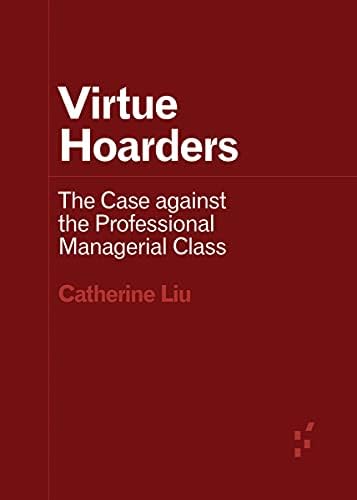 Virtue Hoarders: The Case against the Professional Managerial Class


No comments:
Post a Comment