Kindle$40.03
Available instantly
Hardcover
$329.15
Paperback$56.03
Other Used and New from $56.03
$40.03$40.03

Read sample
Follow the author
George Ciccariello-Maher
Follow
Decolonizing Dialectics (Radical Américas) Kindle Edition
by Geo Maher (Author) Format: Kindle Edition
4.6 4.6 out of 5 stars (19)
Part of: Radical Américas (7 books)
See all formats and editions
Anticolonial theorists and revolutionaries have long turned to dialectical thought as a central weapon in their fight against oppressive structures and conditions. This relationship was never easy, however, as anticolonial thinkers have resisted the historical determinism, teleology, Eurocentrism, and singular emphasis that some Marxisms place on class identity at the expense of race, nation, and popular identity. In recent decades, the conflict between dialectics and postcolonial theory has only deepened. In Decolonizing Dialectics Geo Maher breaks this impasse by bringing the work of Georges Sorel, Frantz Fanon, and Enrique Dussel together with contemporary Venezuelan politics to formulate a dialectics suited to the struggle against the legacies of colonialism and slavery. This is a decolonized dialectics premised on constant struggle in which progress must be fought for and where the struggles of the wretched of the earth themselves provide the only guarantee of historical motion.
Read less
=
Product description
Review
"Decolonizing Dialectics marks an important contribution to a growing body of literature concerned with decolonizing critical - and, more broadly speaking, political - theory, as well as a worthwhile addition to the works devoted to the dialectical tradition and its critics. In particular, Ciccariello-Maher's readings of Fanon and Dussel offer a valuable new take on their respective engagements with dialectical thought, and on the complex and fraught relationship that dialectics shares with decolonization, theoretically and practically."--Michael Elliott "Contemporary Political Theory"
"A light-footed and richly textured work, which demonstrates how radically different historical moments can speak to one another; how dialectics animated by a certain mobility and openness might help to explain, and ultimately transcend, the legacies of colonialism and slavery."--Alex Millen "Journal of American Studies"
"[A] rather unique and sophisticated project that at times leaves the reader breathless from the elegant speed with which it moves through concepts.... [T]his book functions as an opening, by recentering dialectical reason and placing it in service of a radical anti-systemic practice, to successive discussions...."--Joshua Moufawad-Paul "Marx & Philosophy Review of Books"
"Maher's book is an important effort to redefine the dialectic in a more radical and indeed, violent manner."--William L. Remley "Anarchist Studies"
"Decolonizing Dialectics' timeliness lies in the fact that it gives us an approach to these tensions as academics, which exploits their decolonial potential, and affirms, after and through Fanon, their necessary violence, rather than just settle for reciprocity, closure, or another book on dialectics."--Shona N. Jackson "Antipode"
"The author makes important contributions to the fields of dialectics, Marxism, postmodernism, and postcolonial studies, and he has an aptitude for making tough philosophical questions accessible. Decolonizing Dialectics provides an excellent framework for understanding the major theorists he uses as well as Hegel, Marx, Foucault, and several other scholars."--Luis M. Sierra "Journal of Global South Studies"
"Theoretically informed and mindful of the correctives real history offers to speculation, this book is a noteworthy contribution to critical social theory and decolonial discourses. Recommended. Graduate students through faculty."
--B. G. Chang "Choice"
"This clear, well-written and refreshingly forthright book aims to decolonize dialectics and to wield that decolonized dialectics (never, Ciccariello-Maher insists, 'the dialectic') as a method to understand and further decolonization. . . . This is an important work best read in the spirit in which it is written: with urgency, anger, hope and a refusal to simply accept what is present."--David M Bell "Political Studies Review"
"Decolonizing Dialectics makes an essential contribution to our understanding of the dialectic of unity and difference and how difference becomes antagonism within and beyond the legacies of colonialism. It is essential reading in the renewal of debate about the philosophy of internal relations and the systematic dialectic."--Adam David Morton "Progress in Political Economy"
About the Author
Geo Maher is Associate Professor of Politics and Global Studies at Drexel University and the author of We Created Chávez: A People's History of the Venezuelan Revolution, also published by Duke University Press.

TopAbout this itemSimilarFrom the AuthorQuestionsReviews
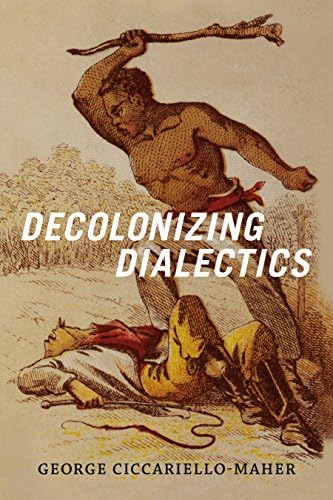 Decolonizing Dialectics (Radical Américas)
Product details
ASIN : B01N1XUXH7
Publisher : Duke University Press Books
Accessibility : Learn more
Publication date : 6 January 2017
Language : English
===
From other countries
R. Soucy
5.0 out of 5 stars A necessary book for any dialectician!
Reviewed in the United States on 31 March 2017
Format: PaperbackVerified Purchase
I DID, unlike most of these reviewers, read this book. I also found it to be a valuable contribution to the project of historical dialectics. I have a background in analytic philosophy (my other reviews being a testament to this), and you can rest assured, the argumentation here is in no way sloppy or suspect as many reviewers have stated.
So what, exactly, is this book? First it is a work within a particular philosophical tradition. If you do not already have a basis in dialectics, or a commitment to left politics, this book isn't for you. The intent is not to convert liberals, centrists, conservatives, rightists; it is to correct a tendency of the left who treat dialectics as a singular, unchanging science in its Eurocentric form. In place of this, the book argues that there is not one The Dialectic, but plural dialectics, and that dialectics are in dire need of addressing and correcting their role in colonialism and their colonial presuppositions. To this end, the book is a glowing success. I have, in fact, treated dialectics as The Dialectic, a continuing thread running though Hegel to Marx, Lenin, Luxemburg, et al. And yet, not a single dialectician I revered represented the positioning of the colonized.
The truth is, the left, including every Marxist, needed this book to be written. Even though I ultimately struggle to see Enrique Dussel's work as emitomizing the project of dialectical theory, the project of decolonizing dialectics overall is a necessary one.
I highly recommend this book, just not to the overly sensitive white folk who coordinated this overnight negative review storm.
106 people found this helpful
Report
Asher W
5.0 out of 5 stars Instant classic
Reviewed in the United States on 3 April 2017
Format: PaperbackVerified Purchase
A beautifully written, incisive exploration of decolonial and postcolonial scholarship's relationship to Western critical theory. Ciccariello-Maher delivers marvelous treatments of Fanon and Dussel, drawing out the crucial insight that colonial violence serves to arrest the dialectic. The colonized is relegated to a stagnant sub-ontology of non-being, the escape from which can only be occasioned by one-sided intervention. (Sometimes you need to be undialectical to put "the dialectic" back into motion.) Additionally, Cicarriello-Maher's takedown of Hardt and Negri is delightful, and the chapter on Venezuela carefully analyzes racial dynamics at play that observers in the Global North too often ignore. Decolonizing Dialectics does exactly what an academic book should: it lays out complicated ideas with such clarity that you feel like an idiot for not thinking of things that way before.
A quick additional note: The bulk of the one star reviews are just angry right-wingers who saw CM on Tucker Carlson and haven't read the book. You can tell because they address no specifics, and they all call the writing "child-like," which is Carlson's description. If you actually take the time to read the book, and you're at least cursorily familiar with the literature he's engaging, you'll probably get a lot out of it. I get the feeling that Decolonizing Dialectics is going to be widely cited for a very long time.
143 people found this helpful
Report
Dr. Tommy J.Curry
5.0 out of 5 stars Excellent book on the dialectics of liberation. Well done sir...well done.
Reviewed in the United States on 13 June 2017
Format: PaperbackVerified Purchase
Decolonizing Dialectics is a rich text that finds a way to synthesize the anti-colonial impulse of dialectics without the errant teleological outlook of racist modern philosophers and thinkers like Hegel. The problem of history, or more appropriately the denigration of Africa throughout modernity, has always placed the philosopher and political theorist at odds with the supposed trajectory of the unfolding of history. Europe has maintained that it is in the course of the world, the living of people within time, that God and truth become manifest. This view asserts that it is the conflicts and changes caused by these conflicts that we move closer to the intentionality of our time. Maher has found a moment, a historical gap of clarity for the oppressed in his analysis which goes beyond the arbitrary exercise of a teleological suspension towards an account of dialectics through which resistance and liberation is in fact methodological.
59 people found this helpful
Report
axel
5.0 out of 5 stars Really liked it.
Reviewed in the United States on 31 March 2017
Format: PaperbackVerified Purchase
I personally enjoyed this book. I found it to be an insightful way to connect two seemingly incompatible things: struggles for decolonization, and the Eurocentric dialectic. Despite all of the controversy around Ciccariello-Maher and his twitter, I find his works to be interesting and arguably essential for the modern leftist to read.
52 people found this helpful
Report
Don Corleone
5.0 out of 5 stars I highly enjoy the incorporation of Fanon and Dussel
Reviewed in the United States on 26 July 2017
Format: PaperbackVerified Purchase
I highly enjoy the incorporation of Fanon and Dussel. Professor Ciccariello-Maher is highly critical this is a must read!
30 people found this helpful
Report
Sponsored
Need customer service?
‹ See all d
조지 시카리엘로-마어(George Ciccariello-Maher, 현재는 Geo Maher로 활동)의 2017년 저작 <탈식민주의 변증법(Decolonizing Dialectics)>에 대한 1,000단어 분량의 요약 및 평론입니다.
===
도서 정보
제목: 탈식민주의 변증법 (Decolonizing Dialectics)
저자: 조지 시카리엘로-마어 (George Ciccariello-Maher)
출판: Duke University Press (2017)
1. 요약: 조화가 아닌 파열로서의 변증법
이 책은 서구 철학의 근간인 헤겔식 변증법을 비판적으로 해체하고, 이를 프란츠 파농(Frantz Fanon)과 엔리케 두셀(Enrique Dussel) 등의 사상을 통해 탈식민주의적 관점에서 재구성하려는 시도다. 저자는 변증법이 본래 가지고 있던 <운동성>과 <급진성>을 회복하기 위해서는, 서구 중심적인 '종합(Synthesis)'과 '화해'의 강박에서 벗어나야 한다고 주장한다.
1) 헤겔 변증법의 식민성 비판
전통적인 헤겔-마르크스주의 변증법은 <정(Thesis) - 반(Antithesis) - 합(Synthesis)>의 구조를 통해 역사가 보편적인 자유와 이성을 향해 나아간다고 본다. 그러나 시카리엘로-마어는 이러한 도식이 <폭력적인 통합>이라고 비판한다. 헤겔의 변증법은 '타자(Other)'를 기존의 시스템(전체성) 안으로 흡수해버림으로써, 식민지인이나 억압받는 자들의 고유한 차이를 말살한다. 즉, 전통적 변증법은 갈등을 봉합하여 지배 질서를 정당화하는 도구로 전락했다는 것이다.
2) 파농의 <비존재의 지대>와 전투적 변증법
저자가 대안으로 제시하는 핵심 개념은 프란츠 파농의 사상이다. 파농은 식민지 상황에서 <주인과 노예의 변증법>이 작동하지 않는다고 보았다. 유럽에서 노동자는 비록 착취당할지언정 '인간'으로 인정받지만, 식민지 원주민은 <비존재의 지대(Zone of Non-being)>에 위치하기 때문이다. 이들은 인간으로 간주되지 않기에 주인(제국주의자)으로부터 인정받을 수 없다.
따라서 탈식민주의 변증법은 상호 인정을 통한 화해가 아니라, <비존재>의 위치에서 솟아오르는 근본적인 <파열(Rupture)>을 지향해야 한다. 이것은 끊임없는 투쟁의 과정이며, 조화로운 합일이 아닌 <불안정한 진동>을 유지하는 것이다. 저자는 이를 <전투적 변증법(Combative Dialectics)>이라 명명한다.
3) 두셀의 <아날렉틱스>와 외부성
이어 저자는 라틴아메리카 해방철학자 엔리케 두셀을 호출한다. 두셀은 변증법(Dialectics)을 넘어선 <아날렉틱스(Analectics, 유비적 사유)>를 제안했다. 변증법이 체계 내부의 모순을 다룬다면, 아날렉틱스는 체계 <외부(Exteriority)>에 존재하는 타자의 목소리에 귀를 기울인다. 억압받는 민중은 지배 시스템의 '부분'이 아니라, 그 시스템이 포착할 수 없는 '외부'에 존재한다. 진정한 해방은 이 외부의 타자가 시스템을 뚫고 들어와 기존 질서를 붕괴시킬 때 가능하다.
4) 소렐과 베네수엘라의 교훈
책의 후반부에서 저자는 조르주 소렐(Georges Sorel)의 <폭력> 개념과 베네수엘라의 볼리바르 혁명 사례를 연결한다. 소렐에게 있어 프롤레타리아의 폭력은 타협을 거부하고 계급 간의 경계를 명확히 하는 <분리>의 행위다. 저자는 이를 베네수엘라의 차베스주의와 연결하며, <국민(Nation)>이라는 허구적 통합 대신 <인민(People)>이라는 당파적이고 투쟁적인 정체성을 구축해야 한다고 주장한다. 베네수엘라의 코뮌(Commune) 운동은 국가라는 거대한 전체에 통합되기를 거부하고, 아래로부터의 급진적 단절을 통해 새로운 주체를 형성하려는 <탈식민적 변증법의 실천>으로 해석된다.
2. 평론: 화해를 거부하는 급진적 사유의 힘과 위험
조지 시카리엘로-마어의 <탈식민주의 변증법>은 서구 좌파 이론이 암묵적으로 전제해 온 <보편적 휴머니즘>에 대한 강력한 기소장이자, 제3세계 혁명 운동에 철학적 정당성을 부여하려는 야심 찬 기획이다.
1) 변증법의 '응급 소생술'
이 책의 가장 큰 미덕은 <죽은 개> 취급을 받거나 <안전한 학문적 도구>로 박제된 변증법에 다시금 피를 돌게 했다는 점이다. 포스트모더니즘이 거대 서사를 거부하며 변증법 자체를 폐기하려 했다면, 시카리엘로-마어는 변증법을 폐기하는 대신 그것을 <급진화>한다. 그는 변증법이 필연적으로 '화해'와 '질서'로 귀결될 필요가 없음을 증명한다. 오히려 역사의 수레바퀴를 굴리는 힘은 합의가 아니라, 영원히 봉합되지 않는 <적대>와 <차이>에서 나온다는 그의 통찰은 오늘날 양극화된 정치 현실을 설명하는 데 유용한 틀을 제공한다.
2) 파농에 대한 탁월한 독해
특히 프란츠 파농에 대한 해석은 이 책의 백미다. 기존의 많은 학자가 파농을 사르트르의 실존주의나 정신분석학의 틀로 읽으려 했다면, 저자는 파농을 <방법론적 혁명가>로 격상시킨다. <비존재의 지대>라는 개념을 통해 서구의 '인권'이나 '민주주의' 담론이 포괄하지 못하는 식민지적 예외 상태를 포착해낸 것은 탁월하다. 이는 오늘날 난민, 불법 체류자, 슬럼 거주자 등 법적 테두리 밖으로 밀려난 이들의 투쟁을 이해하는 데 중요한 시사점을 준다.
3) 베네수엘라 분석의 이론적 깊이
저자는 베네수엘라 현장 연구 경험(이전에 다룬 <Building the Commune> 등)을 바탕으로 이론을 전개하기 때문에, 그의 철학은 추상에 머물지 않는다. 그가 말하는 <탈식민적 파열>은 책상물림의 용어가 아니라, 차베스 시대 빈민가(barrios)에서 벌어진 실제 정치 투쟁을 설명하는 언어다. 그는 베네수엘라의 포퓰리즘을 단순한 선동 정치가 아니라, 식민지적 엘리트(백인/부유층)와 원주민/흑인/빈민 사이의 <타협 불가능한 균열>을 드러낸 철학적 사건으로 격상시킨다.
4) 한계: '종합'의 거부와 영구 혁명의 피로감
그러나 이 책이 제시하는 <종합 없는 변증법>은 실천적인 딜레마를 남긴다. 첫째, 통합의 부재가 낳는 혼란이다. 변증법에서 <합(Synthesis)>을 거부하고 끊임없는 <파열>만을 강조할 때, 사회는 만성적인 내전 상태나 불안정에 빠질 위험이 있다. 베네수엘라의 현재 위기는 기득권의 사보타주 때문이기도 하지만, 혁명 세력이 국가를 안정적으로 운영할 <새로운 보편성>이나 행정적 합리성을 구축하는 데 실패했기 때문이기도 하다. 저자의 논리는 파괴와 저항의 순간에는 강력하지만, 혁명 이후의 사회를 어떻게 건설(Building)할 것인가에 대해서는 다소 모호하다.
둘째, 이분법의 위험성이다. 세계를 <억압하는 내부>와 <저항하는 외부>로 명확히 나누는 것은 선명하지만, 현대 자본주의의 복잡성을 단순화할 수 있다. 오늘날의 권력은 외부를 단순히 배제하는 것이 아니라, 내부로 포섭하여 관리한다. <비존재>의 영역조차 자본의 회로 안에 통합되는 현실에서, 과연 완전한 '외부'를 상정하는 것이 전략적으로 유효한지는 의문이다.
5) 결론: 안정을 거부하는 불온한 철학서
<탈식민주의 변증법>은 읽는 이를 불편하게 만드는 책이다. 이 책은 "우리는 모두 하나"라는 리버럴한 환상을 부수고, 진정한 변화는 목숨을 건 <주인과의 투쟁>과 기존 질서의 <완전한 파괴> 없이는 불가능하다고 외친다. 저자는 서구 좌파들에게 묻는다. "당신들은 정말로 변증법을 원하는가? 아니면 단지 갈등이 해결된 평화로운 결말만을 원하는가?" 이 책은 차베스주의와 같은 급진적 흐름이 왜 서구의 시각에서는 '비민주적'으로 보일 수밖에 없는지, 그리고 왜 그 '비민주성(무질서)'이야말로 탈식민 주체에게는 생존을 위한 유일한 길인지를 설득력 있게 논증한다. 베네수엘라 혁명의 사상적 배경을 이해하고자 한다면, 그리고 서구 중심적 세계관을 깨트리는 철학적 무기를 찾는다면 반드시 읽어야 할 텍스트다.
[Next Step]
지난번 요청하신 <Building the Commune> (Geo Maher, 2016)은 이 책의 저자와 동일 인물이 쓴 책으로, 위의 이론이 실제 베네수엘라 현장에서 어떻게 코뮌 운동으로 구현되었는지를 다루고 있습니다.
혹시 <Building the Commune>에 대한 요약과 평론도 이어서 진행해 드릴까요? (이전 대화 목록에 있었으나 아직 상세 처리가 되지 않은 것으로 보입니다.)


No comments:
Post a Comment