https://archive.org/details/ashioriotof1907s0000nimu/page/90/mode/2up?view=theater

Follow the author
Kazuo NimuraKazuo Nimura
Follow
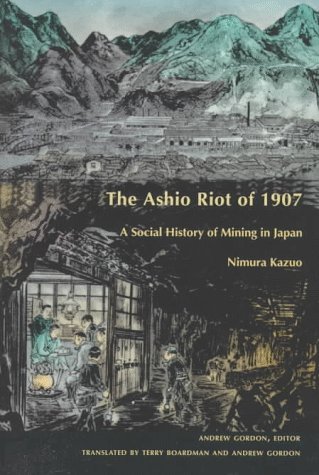
The Ashio Riot of 1907: A Social History of Mining in Japan 1998
by Kazuo Nimura (Author), Andrew Gordon (Editor), Terry Boardman (Translator)
4.0 4.0 out of 5 stars 1 rating
In The Ashio Riot of 1907, Nimura Kazuo explains why the workers at the Ashio copper mine—Japan’s largest mining concern and one of the largest such operations in the world—joined together for three days of rioting against the Furukawa Company in February 1907.
Exploring an event in labor history unprecedented in the Japan of that time, Nimura uses this riot as a launching point to analyze the social, economic, and political structure of early industrial Japan. As such, The Ashio Riot of 1907 functions as a powerful critique of Japanese scholarly approaches to labor economics and social history.
Arguing against the spontaneous resistance theory that has long dominated Japanese social history accounts, Nimura traces the laborers’ unrest prior to the riots as well as the development of the event itself.
Arguing against the spontaneous resistance theory that has long dominated Japanese social history accounts, Nimura traces the laborers’ unrest prior to the riots as well as the development of the event itself.
Drawing from such varied sources as governmental records, media reports, and secret legal documents relating to the riot, Nimura discusses the active role of the metal mining workers’ trade organization and the stance taken by mine labor bosses. He examines how technological development transformed labor-management relations and details the common characteristics of the laborers who were involved in the riot movement.
In the course of this historical analysis, Nimura takes on some of the most influential critical perspectives on Japanese social and labor history.
This translation of Nimura’s prize-winning study—originally published in Japan—contains a preface by Andrew Gordon and an introduction and prologue written especially for this edition.
==
Review
"Nimura is by all measures a leading figure in the field of Japanese labor history. And he has much to tell us about how labor in Japan was transformed in the Meiji period from traditional structures to a newer and more ‘modern’ system."—Fred G. Notehelfer, UCLA Center for Japanese Studies
About the Author
Kazuo Nimura is Professor of History at the Ohara Institute for Social Research at Hosei University, Japan. Andrew Gordon is Professor of History at the Reischauer Institute of Japanese Studies at Harvard University.
Kazuo Nimura is Professor of History at the Ohara Institute for Social Research at Hosei University, Japan. Andrew Gordon is Professor of History at the Reischauer Institute of Japanese Studies at Harvard University.
==
Review
"Nimura is by all measures a leading figure in the field of Japanese labor history. And he has much to tell us about how labor in Japan was transformed in the Meiji period from traditional structures to a newer and more ‘modern’ system."—Fred G. Notehelfer, UCLA Center for Japanese Studies
About the Author
Kazuo Nimura is Professor of History at the Ohara Institute for Social Research at Hosei University, Japan. Andrew Gordon is Professor of History at the Reischauer Institute of Japanese Studies at Harvard University.
Kazuo Nimura is Professor of History at the Ohara Institute for Social Research at Hosei University, Japan. Andrew Gordon is Professor of History at the Reischauer Institute of Japanese Studies at Harvard University.
Top review from the United States
C. Franz
4.0 out of 5 stars Fred Notehelfer of the UCLA Center for Japanese Studies says
Reviewed in the United States on May 31, 2006
"Nimura is by all measures a leading figure in the field of Japanese labor history. And he has much to tell us about how labor in Japan was transformed in the Meiji period from traditional structures to a newer and more 'modern' system."
I would just add to this that Nimura succeeds in doing something like what E.P. Thompson did in his study of English bread riots - explaining a particular labor conflict in a way that shows its broader significance. I found this case interesting for the light it cast the relationships of labor and capital in the formative decades of industrial Japan. Some of the book is engaged in a guild conversation among historians of Japan, but as a generalist interested in labor and global capitalism, there was plenty to keep me reading as well. Nimura's discussion of "migrant labor" in industrializing Japan was particularly fascinating.
One person found this helpful


No comments:
Post a Comment