Hardcover
$42.40
Paperback
$35.08

Follow the author

Michael HardtMichael Hardt
Follow
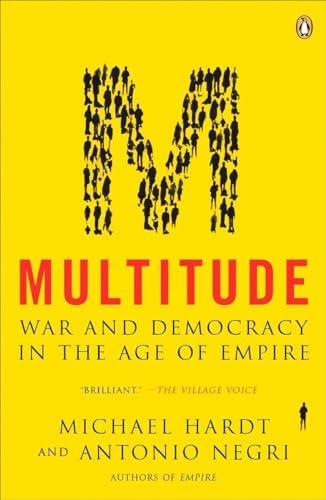
Multitude: War and Democracy in the Age of Empire Paperback – 26 July 2005
by Professor Michael Hardt (Author), Antonio Negri (Author)
4.7 4.7 out of 5 stars (37)
Edition: Annotated
See all formats and editions
Or $8.77 /payment at 0% (Pay in 4). View 2 plans
In their international bestseller Empire, Michael Hardt and Antonio Negri presented a grand unified vision of a world in which the old forms of imperialism are no longer effective. But what of Empire in an age of "American empire"? Has fear become our permanent condition and democracy an impossible dream? Such pessimism is profoundly mistaken, the authors argue. Empire, by interconnecting more areas of life, is actually creating the possibility for a new kind of democracy, allowing different groups to form a multitude, with the power to forge a democratic alternative to the present world order.Exhilarating in its optimism and depth of insight, Multitude consolidates Hardt and Negri's stature as two of the most important political philosophers at work in the world today.
Report an issue with this product
ISBN-10
0143035592
ISBN-13
978-0143035596
Next slide of product details
See all details
Review
"This timely book brings together myriad loose strands of far left thinking with clarity, measured reasoning and humor." --Publishers Weekly, starred
"Impressive... a rare and exciting work of synthesis." --Booklist, starred review
"Brilliant." --The Village Voice
"An inspiring marriage of realism and idealism." --Naomi Klein, author of No Logo
About the Author
Michael Hardt is a professor in the literature program at Duke University.
Antonio Negri is an independent researcher and writer and a political prisoner recently released from house arrest in Rome, Italy. He has been a lecturer in political science at the University of Paris and professor of political science at the University of Padua.

TopAbout this itemSimilarFrom the AuthorQuestionsReviews
 Multitude: War and Democracy in the Age of Empire
Product details
Publisher : Penguin Publishing Group
Publication date : 26 July 2005
Edition : Annotated
Language : English
Print length : 448 pages
ISBN-10 : 0143035592
ISBN-13 : 978-0143035596
Item weight : 386 g
Reading age : 18 years and up
Dimensions : 13.97 x 2.57 x 21.44 cm
Best Sellers Rank: 680,439 in Books (See Top 100 in Books)477 in International Relations Textbooks
558 in Political Ideologies Textbooks
566 in Political History Textbooks
Customer Reviews:
4.7 4.7 out of 5 stars (37)
===
From other countries

nishiuch
5.0 out of 5 stars けっこうよくできているReviewed in Japan on 7 February 2005
Format: HardcoverVerified Purchase
〈帝国〉以来の共著だけど、二人の個性の違いが出てきた感じ。
議論そのものの説得力は上がってるし、マルチチュードの位置づけも
まっとうなものになったし。
次回作がさらに期待できるね。スティグリッツなんかより、的場昭弘さんのものなんかも読むといいんだけどね。
Report
Translate review to English
Hanan
5.0 out of 5 stars Important readReviewed in the United Kingdom on 12 June 2016
Format: PaperbackVerified Purchase
One of the most important books of the 21 century. Read it if you want the world to make sense.
Report

Malvin
5.0 out of 5 stars The reasons why we need to move forwardReviewed in the United States on 2 October 2004
Format: HardcoverVerified Purchase
"Multitude" by Michael Hardt and Antonio Negri is a follow-up to the author's widely-acclaimed "Empire". In "Multitude", Hardt and Negri discuss change and the possibility of global democracy, which they define as "the rule of everyone by everyone". The book offers a unique vision of how such a future might be developing around us and futher rewards its readers with numerous insights and top-notch analysis in a highly readable text.
"Multitude" appears to have been written in part as a response to the criticisms of "Empire" as presented in the excellent book, "Empire's New Clothes: Reading Hardt and Negri" edited by Passavant and Dean. For example, "Multitude" takes a slightly different approach to the themes of U.S. exceptionalism, network power structures, violence and the politics of identity; all of these topics were critiqued at length in "Empire's New Clothes". Consequently, it appears that Hardt and Negri may have profited from this dialogue and it may also explain why "Multitude" is a more substantive and less theoretical book than "Empire".
Section One of "Multitude" is entitled "War". Hardt and Negri discuss the perpetual state of war as a means to maintain the capitalist world order and social hierarchy. Interestingly, the authors show how insurgencies and counterinsurgencies have both taken on the characteristics of flexible, postmodern production networks. Importantly, the anti-globalization movement is lauded as an example of how such decentralized and distributed networks can support an "absolutely democratic organization" whose emerging strength might yet constitute the "most powerful weapon against the ruling power structure."
Section Two is about "Multitude". The multitude is both plural and multiple, wherein people maintain their individualities but act based on common interests. Hardt and Negri posit that global production is made possible by "the commons" of language and communications and information networks. Patents, licenses and other tools to control the commons and appropriate wealth for private investors has hampered the productivity of the multitude, the authors believe, thereby creating a tension that might lead to revolution. To that end, recent events in Argentina are held out as examples of how new forms of collaborative democracy might emerge.
Section Three is entitled "Democracy". Hardt and Negri explain how the ecological and economic grievances of the multitude are routinely suppressed in favor of corporate interests. The authors endorse a number of reforms that might alleviate some of the worst excesses -- such as the Tobin Tax on currency trades, the easing of copyright laws and the forgiveness of third world debt -- but they go much further, suggesting that the time may be ripe for a "new Magna Carta", or a fundamental restructuring of relations between capital and labor. To that end, the authors envision an "open-source society" of collaboration characterized by the self-rule of the multitude and using the commons as the basis of social and economic production.
In my view, one of the key attributes of "Multitude" is its convincing analysis and description of today's post-democracy world. Hardt and Negri describe how the three major tenets of U.S. democracy -- the media, the separation of powers, and representation -- have been irreparably coopted by corporate power. This, of course, is an observation that has been made elsewhere but rarely with the penetrating analysis and skill that these intelligent authors bring to bear on the subject. If "Multitude" does nothing else than to serve to widen the discussion on this critically important topic, it will have made an important and lasting contribution.
However, I am less convinced that the open-source community envisioned by Hardt and Negri will spontaneously emerge as they have suggested. The disconnect between the aspirations of the multitude for shared peace and prosperity on the one hand and the brutal realities of hierarchical power structures on the other has existed for centuries. While one is certainly hopeful that the historic moment has changed and has made a revolution in human relations possible, the authors provide little in the way of guidance as to how the multitude might cross the divide. Still, "Multitude" serves as a thought-provoking and inspirational work that helps us understand the reasons why we need to move forward to a more peaceful and humane world, if not how to get there, and easily deserves a five-star rating. I highly recommend it to all.
76 people found this helpfulReport

ysdxfcghvjb
5.0 out of 5 stars Must read!Reviewed in Germany on 17 March 2020
Verified Purchase
One of the most profound and important publications on globalisation, tackling contemporary phenomena and historic trajectories in a very critical, but reputable way
Report

Ben
5.0 out of 5 stars Where we are atReviewed in the United States on 18 February 2013
Verified Purchase
A well researched and thoughtful examination of where our nation currently resides. The unvarnished examination is a welcome change. The key to this examination is how it fits into the global scheme and I believe the authors accurately assess that functionally we can be considered a multitude rather than any other sovereign grouping.
2 people found this helpfulReport
Nicolas R.
4.0 out of 5 stars Good enoughReviewed in the United States on 11 July 2013
Format: PaperbackVerified Purchase
The pages are marked with pen or pencil, but the book it is about political philosophy so as long as you can read it is OK
Report
Ali A
5.0 out of 5 stars Great Book ! An indicator to the events which rocked the world in 2011Reviewed in the United States on 8 November 2011
Format: PaperbackVerified Purchase
I loved the book and I found it very interesting. Although, as usual there are some critisim but overal it has my vote as an interesting book.
If you want to have a better perspective on what has been going on in the world, especially the events that have started in middle east to the one in Wall Street then you need to read this book.
2 people found this helpfulReport
Theodore Verde
5.0 out of 5 stars Five StarsReviewed in the United States on 5 August 2014
Format: PaperbackVerified Purchase
Thank you for your prompt service and well represented product
Report
====


No comments:
Post a Comment